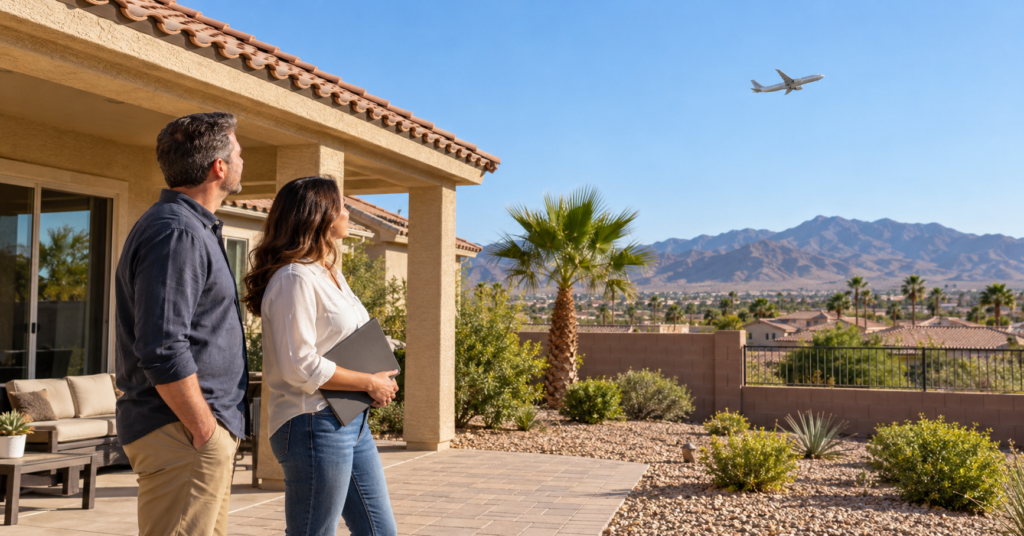
Las Vegas airport noise deserves a place on your homebuying checklist before you commit to a property. A quiet showing gives you one observation, but it cannot establish what you will hear while sleeping, working from home or spending an evening outside.
Check the exact address against official aviation information, arrange visits around your household’s schedule and investigate any promises about noise reduction. Each step answers a different question about whether the home will suit your daily life.
Identify the Aviation Activity Around the Address
Start with the property’s street address and parcel location. A neighbourhood name or the driving distance to an airport is too broad for evaluating a particular home.
Clark County’s Department of Aviation publishes maps covering Harry Reid International Airport, North Las Vegas Airport, Henderson Executive Airport and helicopter tour operations. Its realtor resources include both flight tracks and noise contours. Review the materials relevant to the property rather than assuming Harry Reid is the only possible source.
Save the map title, date and property location with your purchase records. If you cannot confidently place the home on a map, ask the department for help interpreting it.
For a property potentially affected by military flights, investigate Nellis Air Force Base separately. The base has issued advisories about increased aircraft noise during training, so civilian airport information alone may leave a gap in your research.
Compare Different Runway Configurations
Check more than the flight pattern operating during your first visit.
The county’s materials show several configurations at Harry Reid. The typical configuration includes arrivals from the north and east and departures toward the west and south. Separate maps show northeast and northwest traffic flows, with different arrival and departure directions.
Locate the property on each relevant map. A home that appears away from one group of flight tracks may sit closer to another.
If someone says aircraft rarely pass overhead, ask what period that observation covers. A seller who is usually away during the day may have limited experience of daytime activity.
Where a configuration could materially affect your decision, ask airport planning staff how to interpret the published information. Do not treat a flight-track illustration as a promise that every aircraft will follow an identical line.
Understand What Noise Contours Measure
Noise contour maps describe exposure using a defined measurement method. They are not recordings of what you will hear from a particular room.
The Federal Aviation Administration explains that day-night average sound level, or DNL, represents cumulative exposure for an average day based on annual aircraft operations. Different combinations of flight frequency and loudness can produce the same DNL value.
A contour labelled 65 DNL therefore does not mean every passing aircraft produces a steady 65-decibel sound at the house. Individual events and the quiet intervals between them are separate considerations.
The practical implication is that a contour cannot settle whether the noise will interrupt your sleep or conversations. Use it to understand the mapped exposure, then assess the property itself.
Check the map’s date and whether it describes existing or projected conditions. Ask for clarification if the document’s purpose or assumptions are unclear.
Arrange Visits Around Your Actual Routine
Choose viewing times that reflect when you need the home to be comfortable.
Someone working a casino night shift may need daytime quiet. A remote worker may care most about interruptions during calls. Another household may place greater value on using the patio after dinner.
Where access can be arranged, consider:
- A visit during your normal sleeping hours.
- A weekday visit during your usual work period.
- An evening visit when you would use outdoor spaces.
- A return visit if the first appointment provides little opportunity to observe aircraft activity.
Keep a simple record of the visit’s duration, location and noticeable interruptions. Note whether you paused a conversation or lost concentration, rather than recording only that a plane passed.
Ask nearby residents specific questions about timing and frequency. Their observations can help you plan another visit, but their tolerance for noise may differ from yours.
Listen Inside the Rooms You Will Use
A driveway conversation does not tell you how the main bedroom or upstairs office will feel.
With permission, spend time in the rooms that matter most. Close exterior doors and windows as you normally would, and ask for background music or television to be turned off. Note whether air conditioning or other equipment is running during the assessment.
Then check the outdoor areas separately. A comfortable interior does not establish that a balcony, pool area or patio will meet your expectations.
For an open-plan home, consider whether you would have a separate room available for calls or rest. In a condominium, assess the actual unit and balcony rather than relying on what you hear in the lobby.
If the purchase depends on achieving a particular indoor noise level, ask an acoustical professional what assessment would be appropriate. A brief personal visit should not be presented as a formal sound test.
Review Disclosures and Recorded Documents
The county publishes an Airport Noise Disclosure Statement with its realtor information. Ask your agent which airport-related disclosures apply to the transaction and obtain them early enough to review them carefully.
Raise specific questions with the seller:
- Have they made aircraft-noise complaints?
- Have they received correspondence about nearby aviation activity?
- Was any work completed specifically to reduce aircraft noise?
- Are invoices, specifications or programme records available for that work?
If the title report identifies an airport-related easement or restriction, request the underlying recorded document. Ask the title officer to identify its connection to the parcel and obtain legal advice if its effect is unclear.
Avoid relying on a casual description such as “standard airport paperwork.” You need to understand the documents attached to the property you are buying.
Investigate Sound Insulation Before Budgeting for It
If the home seems suitable only after improvements, establish what those improvements would involve before treating them as an affordable solution.
Ask a qualified professional to assess the relevant rooms and explain the proposed work. Request a written scope identifying which windows, doors or other components would be addressed, what performance is expected and what limitations would remain.
For previous upgrades, obtain records showing what was installed and where. A listing’s reference to replacement windows does not establish their acoustic performance.
Keep potential public assistance separate from your renovation budget. The FAA describes residential sound-insulation consideration in connection with airport noise studies and qualifying exposure areas, and directs homeowners to the local airport for programme information. That does not establish eligibility for a particular Las Vegas address.
Before allowing for financial assistance, confirm whether a programme is available, whether the property qualifies and whether any work has actually been approved.
Resolve Address-Specific Questions Before Your Deadline
Give airport staff a precise inquiry: the property address, the dates and times of your observations, and the map or flight pattern you are trying to understand. This is more useful than asking whether an entire neighbourhood is quiet.
The FAA recommends contacting the local airport first about community flight patterns, operating hours and aircraft-noise concerns. Military aviation questions should go to the relevant military installation.
Coordinate the remaining research with your agent and the deadlines in your purchase agreement. If an important question remains unanswered, discuss the available contractual options before the applicable deadline passes.
Keep written responses, assessment estimates and your own visit notes together. They should show what you established about the address and which uncertainties still affect your willingness to buy.
Note: The Clark County Department of Aviation’s realtor information page provides local flight-track maps, noise contours and airport disclosure materials for property research.