Las Vegas pool draining requires a clear plan for where the water will go. Before arranging equipment or scheduling maintenance, homeowners need to establish whether the property connects to a public sewer, where the appropriate access point is located, and how the discharge will be monitored.
These checks are especially useful when you have recently bought a home or have never supervised a water replacement. A previous owner’s drainage method should not be your only reference.
Confirm the Approved Discharge Route
For properties where a public sanitary sewer is available, the Las Vegas Valley Water District identifies off-property pool drainage as a prohibited form of water waste. Sending water toward a street gutter is not an acceptable substitute for using the appropriate sewer connection.
The distinction matters because the sanitary sewer and storm drainage systems serve different purposes. Household wastewater travels to treatment facilities, while storm runoff can carry pollutants toward the Las Vegas Wash and Lake Mead without that treatment.
Confirm the jurisdiction responsible for your property and describe the proposed discharge route before proceeding if anything is unclear. Ask the contractor to identify the receiving connection during the site visit, rather than leaving that decision until pumping begins.
Locate the Cleanout Before Booking the Work
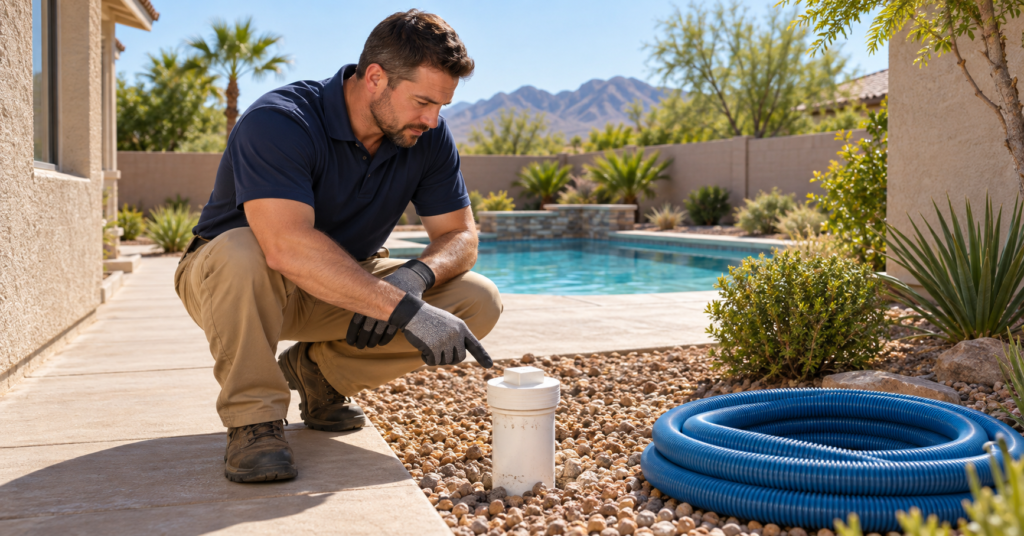
A sewer cleanout provides access to the property’s sewer line. The City of Las Vegas describes a typical residential cleanout as a capped pipe near ground level, often toward the front of the home. Landscaping can conceal it, and professional help may be needed to locate or restore access.
Walk the property with the person handling drainage and confirm:
- Which opening connects to the sanitary sewer.
- Whether the cap is accessible and can be removed appropriately.
- Whether the proposed hose route crosses gates, walkways, or other occupied areas.
- Whether locating or repairing access is included in the quoted work.
A photograph can help you remember the location, but it cannot establish the condition of the buried pipe.
Wall-mounted cleanouts deserve particular attention. LVVWD warns that using these can create a greater risk of water backing up inside the home.
Establish How Much Water Actually Needs Replacing
Ask the pool professional whether the work requires a partial replacement or a complete drain. LVVWD recommends discussing that decision with a pool-care professional based on maintenance needs and water quality.
Request a clear explanation of the problem being addressed and the proposed stopping level. “Drain the pool” is too vague when different amounts of water could be removed.
Have the agreed scope recorded in the work order. This gives both parties the same reference if the technician arriving on the day is different from the person who prepared the estimate.
Match the Discharge Rate to the Sewer’s Capacity
The Southern Nevada Water Authority gives 12 gallons per minute as the maximum recommended discharge rate, while warning that a safe rate may be lower. Its guidance also says to stop and contact a professional plumber if water backs up into household drains.
Ask how the contractor will control the actual discharge rate. A pump’s ability to move water quickly does not establish what your connection can receive.
Allow enough time for the agreed rate. As a simple calculation, removing 6,000 gallons at a steady 10 gallons per minute takes 600 minutes, or 10 hours, before interruptions. That example is a scheduling illustration, not a recommended rate for your property.
Identify who will monitor the discharge and who can stop it immediately. If the proposed schedule depends on increasing flow beyond what the plumbing can accept, change the schedule.
Use Separate Guidance for a Septic Property
A property with septic requires a different disposal plan. The Southern Nevada Health District prohibits disposing of pool or spa water into or over the septic system. Pool-filter backwash also must not enter that system because the additional water can overload it.
Contact the agency responsible for the property before arranging drainage. The Health District’s pool-draining guide for septic properties identifies the relevant local contacts.
Explain where you intend to discharge the water and ask what preparation, conditions, or authorization apply. Record the instructions you receive and share them with the contractor. Advice for a sewer-connected property does not resolve the disposal question for a septic property.
Agree on Equipment and Site Responsibilities
LVVWD’s preparation guidance includes switching off power to the pool’s filtration system at the circuit breaker and shutting off the automatic fill valve before drainage. If the pool has a dedicated sewer connection, the district directs owners to the operating instructions or their pool contractor.
Clarify who will handle those tasks and restore the equipment afterward. This is particularly useful when a pool technician and plumber are working on different parts of the job.
Arrange access to any controls the technician needs, keep the hose route clear, and agree on how the property will be secured while work is underway. If you rent the home, coordinate the work and any plumbing changes with the owner before scheduling.
Plan the Refill Around the Pool Surface
The refill plan should be ready before water is removed. SNWA advises refilling promptly because direct sunlight can damage exposed plaster. Its guidance also calls for checking water chemistry after replacement.
Ask the pool professional how the proposed work affects refill timing for your particular surface. If repairs or surface treatments are involved, obtain instructions specific to that work.
Confirm whether the service includes restarting equipment, adjusting the water chemistry, and explaining when the pool can be used again. These responsibilities should have a named person and an agreed handover point, particularly if the homeowner will finish the refill after the technician leaves.
Estimate the Water Bill Separately From the Service Quote
The contractor’s charge and the cost of replacement water are separate parts of the budget.
LVVWD uses tiered water rates, and single-family residential customers can also incur an excessive-use charge when their consumption exceeds the applicable threshold. Billing-period length affects usage thresholds, so a simple estimate based on the cheapest advertised water rate can be misleading.
Use the district’s water rates and bill estimator, or contact your own provider if another utility serves the property. Include your expected household consumption alongside the planned refill volume.
For the service quote, ask whether cleanout access work, additional attendance, equipment hire, and post-refill treatment are included. Request approval before any extra work proceeds. Keeping those charges separate makes it easier to understand what changed if the final cost differs from the original estimate.
Note: This article provides general information for private residential pools. Drainage requirements and suitable methods depend on the property, jurisdiction, plumbing, and pool construction. Confirm current local guidance and obtain site-specific advice from a qualified pool professional or licensed plumber before proceeding.