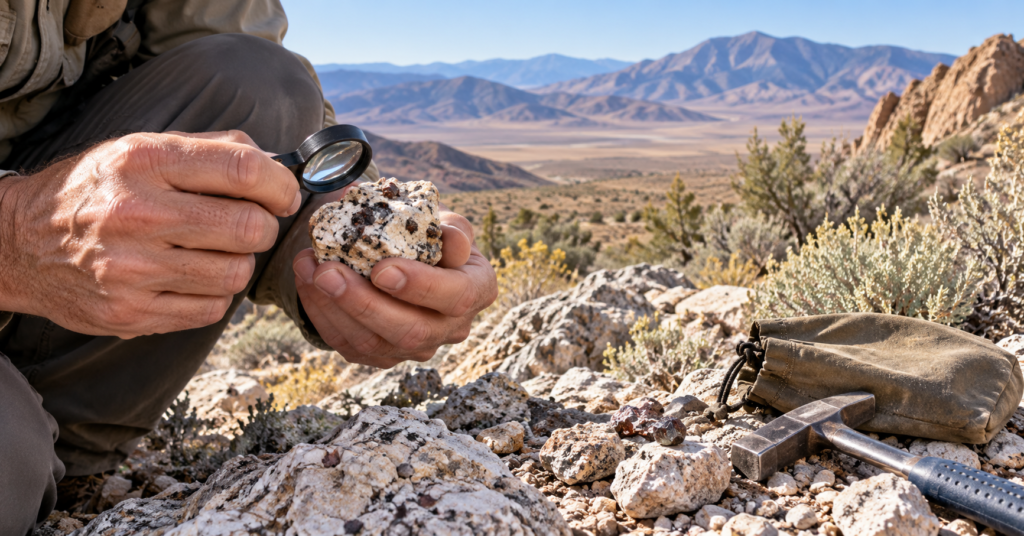
Nevada rockhounding starts with a question that a photograph of a promising hillside cannot answer: are you allowed to take anything home?
A loose crystal, a fossil embedded in stone, and a piece of petrified wood can fall under different collection rules. Before packing a rock hammer, identify the exact location, the material you hope to find, and the method you plan to use. Those details determine which checks matter for your trip.
Identify Who Manages the Collecting Site
Begin with the specific parcel where you intend to search. A location described online as “public land” needs more investigation before you collect.
The Bureau of Land Management generally allows reasonable personal collections of rocks and mineral specimens on eligible BLM land. Exceptions include developed recreation sites, certain mineral operations, and areas with privately owned mineral rights. Its rockhounding guidance provides a useful starting point.
Other public destinations have different rules. Valley of Fire State Park prohibits removing or disturbing rocks and fossils. An entrance payment does not provide collection permission.
Save the coordinates of your intended search area. A precise location gives agency staff something useful to check when you ask about restrictions.
Research Mining Claims Before Taking Samples
A mining claim can affect collection rights even when the surrounding landscape appears undeveloped. BLM guidance requires the claimholder’s permission before collecting within an existing claim.
The BLM Nevada mining and minerals office can help visitors access mining claim records, land status information, and maps. Use those resources to investigate the actual collecting footprint.
If permission is available, ask which boundaries, materials, tools, and dates it covers. Keep a written copy with your trip information.
Private or patented land also requires the owner’s permission. Nevada’s Division of Minerals specifically cautions that a locality appearing on a rockhounding map does not itself authorize collection.
Identify Fossils Before Removing Them
Fossils need closer attention than ordinary mineral specimens.
On BLM land open to casual fossil collecting, common invertebrate fossils, such as certain shells and trilobites, and common plant fossils may be collected for personal use. BLM’s published guidance gives a general daily allowance of up to 25 pounds of common nonvertebrate fossils per person.
Vertebrate fossils, uncommon invertebrate or plant fossils, and fossil trackways require a research permit for collection. That includes fossil fish and mammals as well as dinosaurs. Making a mold or cast is also restricted.
If identification is uncertain, leave the specimen where it is. Photograph its appearance and surroundings, record the location, and contact the local BLM office. Avoid breaking open the surrounding rock to investigate a potentially protected discovery.
Track Petrified Wood Separately
Petrified wood has its own numerical limits on eligible BLM land. Unless a location has different restrictions, the allowance is 25 pounds plus one additional piece per person per day, with a maximum of 250 pounds per person per year.
The additional daily piece still contributes to the annual total. Keep a running weight record if you collect on several trips, and leave enough room below the limit to account for measurement uncertainty.
Do not apply this allowance to every rock you find. BLM’s general guidance for ordinary rocks, mineral specimens, and semiprecious gemstones uses a “reasonable amounts” standard rather than the petrified wood formula.
A collection limit is a ceiling, not a target for filling your vehicle.
Check Whether Your Tools Change the Requirements
Permission to collect does not automatically authorize every extraction method.
BLM explains that permits may become necessary because of the equipment involved or the amount of surface disturbance. Before bringing powered equipment or planning substantial excavation, describe the proposed work to the managing office.
Where collection is permitted in BLM wilderness, methods are limited to nonmotorized hand tools, minimal surface disturbance, and compliance with the applicable management plan. Special designations can add further restrictions.
Ask practical questions: may you pick up loose specimens, break exposed rock, or dig? These are different activities. An answer about surface collection should not be treated as approval to excavate a mineral seam.
Leave Worked Stone and Historic Objects in Place
An attractive piece of stone may also be a cultural object.
BLM identifies projectile points, stone tools, pottery, historic bottles, and remnants of historic structures as materials visitors must leave in place. Their presence on the surface does not make them available as souvenirs.
If a piece appears deliberately shaped, resist the urge to clean it, test its hardness, or move it beside another object for a photograph. Record what you can without disturbing the find.
For families, establish this distinction before searching begins. Children should ask an adult about unfamiliar objects before adding them to a collection bag.
Consider Garnet Hill for a Focused First Trip
A recognized collecting area can make planning more straightforward.
Near Ely, Garnet Hill is a BLM-designated rockhounding area where garnets occur in volcanic rhyolite. BLM describes two ways to search: examining the ground for weathered-out crystals and carefully breaking rock.
Surface searching offers a way to begin without immediately using a hammer. Look closely at loose material and learn to recognize the dark crystals before deciding which specimens to keep.
BLM lists no entrance fee and notes that water is unavailable. The site sits at approximately 7,000 feet, so account for its elevation when planning the visit.
Keep Your Search Away From Abandoned Mine Openings
An old mine entrance can look like a shortcut to interesting minerals. It also introduces hazards that an ordinary surface search does not.
Nevada’s Division of Minerals warns about unstable timbers, cave-ins, old explosives, dangerous air, and falls at abandoned mines. Stay outside underground workings and keep children away from openings.
Choose a search area that does not require approaching a shaft or entering a tunnel. A specimen visible inside an opening is not a reason to investigate further.
Decide How You Will Use Your Finds
BLM’s ordinary recreational collection allowance is for noncommercial purposes. Collecting inventory for online sales, a shop, or another source of financial gain falls outside that general allowance. Discuss any proposed commercial activity with the agency before removing material.
For a personal collection, label specimens while the details are fresh. Record the collection date, location, tentative identification, and any permission associated with the trip. Use separate bags or numbered labels when visiting multiple sites.
These notes make your collection more useful later. A mineral’s appearance may help identify it, but knowing where it came from gives you additional information to investigate.
Note: Collection rules depend on the land manager, mineral rights, material, and site restrictions. Verify current requirements for your exact destination before removing specimens.