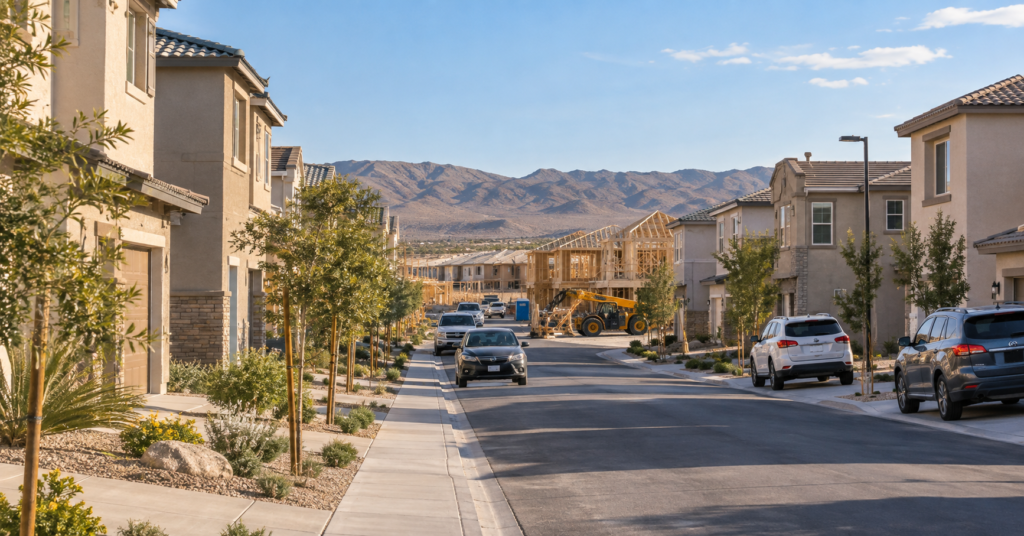
Living in Cadence Henderson can provide access to newer housing, parks and planned community features, but the experience may vary considerably from one section to another. Some streets feel established, while nearby areas may still be affected by homebuilding, roadwork and commercial development.
Prospective residents should evaluate the exact block and construction phase instead of judging the entire community from a model-home area or a single daytime visit. Lot dimensions, street activity, travel routes and remaining development can all influence daily life.
Understand the Community’s Development Stage
Master-planned communities are usually completed in phases. Residents may move into one finished street while builders continue working on vacant parcels nearby.
Before choosing a home, determine what has been completed and what could still be built. Ask about:
- Vacant land surrounding the property
- Planned residential phases
- Future commercial areas
- Proposed schools or public facilities
- Temporary and permanent road connections
- Construction access routes
- Estimated completion periods
An open area providing a mountain view today may already be designated for additional homes. Request current planning information instead of relying on the appearance of undeveloped land.
The presence of active construction is not automatically negative. It means residents should understand how long temporary conditions may last and what the completed area is expected to contain.
Compare Different Cadence Streets in Person
A neighborhood name does not guarantee identical surroundings. Housing density, lot size, sidewalk placement and vehicle activity can change within a short distance.
Visit several streets rather than focusing only on the home itself. Notice whether the street includes:
- Detached homes or attached housing
- Alleys or front-facing garages
- Guest-parking spaces
- Completed landscaping
- Nearby construction entrances
- Direct access to a larger road
- Pedestrian routes to parks
- Empty parcels awaiting development
A quiet interior street may offer a different experience from a property near a community entrance, school route or future commercial site.
How Lot Spacing Affects Privacy
Closely spaced homes can make efficient use of land, but buyers and renters should think carefully about windows, patios and everyday noise.
Stand inside the bedrooms, kitchen and main living area. Look through each window to determine whether it faces a neighboring wall, backyard, upstairs window or frequently used outdoor space.
Important privacy checks include:
- Distance between facing windows
- Views into the backyard from neighboring upper floors
- Placement of patios and balconies
- Location of outdoor air-conditioning equipment
- Noise from side-yard gates
- Shared or closely positioned driveways
- Window coverings needed for daily privacy
Touring an empty house can make the lot feel more private than it will after surrounding homes are occupied. Return during evenings or weekends when more residents are home.
Check Backyard Usability, Not Just Its Dimensions
A yard’s listed measurements do not explain how comfortably it can be used. Air-conditioning equipment, utility panels, drainage areas and narrow side yards may reduce the practical space.
Observe the yard at different times of day. A west-facing outdoor area may be difficult to use during summer afternoons, while a shaded yard could feel very different despite having similar dimensions.
Consider whether there is enough room for the activities that matter to your household, such as:
- Outdoor dining
- Children’s play equipment
- Pet exercise
- Gardening
- Secure storage
- Shade structures
- A grill with appropriate clearance
Before planning permanent improvements, review the applicable community rules and City of Henderson permit requirements.
Construction Noise Can Change by Block
Construction activity can include heavy equipment, concrete work, delivery trucks, backup alarms and crews arriving early in the day. The effect depends on the property’s distance from current building sites and access roads.
A model home may be positioned away from the noisiest work. Visit the specific property during a normal weekday morning to understand actual conditions.
Ask where construction vehicles enter the neighborhood and whether they pass the house. A property several blocks from active building may still experience truck traffic if it sits along the primary route.
Noise also changes as development moves. Work beside the house may eventually stop, but another phase can begin farther down the same road.
Dust Requires Practical Planning
Southern Nevada’s dry soil allows construction traffic and wind to carry dust across developing areas. Residents may notice it on patios, outdoor furniture, vehicles and window tracks.
Homes closest to disturbed land generally face the greatest exposure, but prevailing winds and construction routes also matter.
Inspect:
- Door and window seals
- Garage-door gaps
- Exterior vents
- HVAC filter condition
- Dust accumulation on window sills
- Patio and furniture surfaces
- Landscaping barriers
Frequent dust does not necessarily indicate a building defect. However, poor seals can allow more particles indoors and make routine cleaning harder.
Ask how often the HVAC filter needs to be changed under current conditions. The appropriate schedule depends on the equipment, household and surrounding activity.
Living in Cadence Henderson During Summer
Young communities often have smaller trees and less mature shade than established Henderson neighborhoods. Sidewalks, playgrounds and yards that feel comfortable in spring can become much hotter during summer.
Visit the property in the afternoon and observe which exterior areas receive direct sunlight. Consider the location of:
- Entry doors
- Driveways
- Children’s play areas
- Dog-walking routes
- Mailboxes
- Park paths
- Outdoor seating
- West-facing windows
A short walk to a park may feel considerably longer when the route has little shade. Residents with children, pets or heat-sensitive family members should consider how outdoor routines will change during the hottest months.
Our guide to experiencing a full Las Vegas summer before buying a home explains why summer conditions should be evaluated before making a long-term housing decision anywhere in the Las Vegas Valley.
Test the Home’s Cooling Performance
Newer construction alone does not guarantee even indoor temperatures. Window direction, insulation, duct design, thermostat location and the position of neighboring homes can all affect comfort.
During a showing, compare temperatures between upstairs and downstairs rooms. Check bedrooms above the garage and rooms with substantial western exposure.
Ask for available electricity bills covering the hottest months. The current household’s usage will not perfectly predict your costs, but it can provide useful context.
Also determine whether the garage, patio or side yard contains mechanical equipment that produces noticeable noise near bedrooms or outdoor seating.
Evaluate Traffic at the Times You Will Travel
A short test drive in the middle of the day may not represent the actual commute. Repeat the route during the morning rush, afternoon school period and evening traffic.
Test more than one exit from the community. A route that looks convenient on a map may depend on a congested intersection, ongoing roadwork or a series of traffic signals.
Record the real travel time to places you use regularly, including:
- Work
- School or childcare
- Grocery stores
- Medical appointments
- Interstate connections
- Family members
- Recreation
- The airport
Do not evaluate only the distance. A slightly longer route with more predictable traffic may be easier to manage than a shorter route affected by construction or school congestion.
Account for Regional Road Projects
Traffic outside Cadence can also affect daily travel. Henderson and state transportation projects may change lane configurations, interchange access and travel patterns.
The City of Henderson public works project information can help residents identify municipal work, while the Nevada Department of Transportation’s Henderson Interchange page provides information about a major regional transportation project.
Project schedules can change, so check current notices shortly before signing a lease or completing a home purchase. Ask whether your primary route includes planned closures, lane restrictions or detours.
Drivers adapting to Las Vegas Valley traffic may also benefit from our guide to Las Vegas intersection safety.
Observe School-Related Traffic
Even households without children can be affected by school arrival and dismissal traffic. Lines of vehicles, buses and pedestrian crossings may temporarily slow nearby streets.
Visit the area around the beginning and end of the school day. Notice whether vehicles queue near the property or use residential streets as shortcuts.
Families should confirm school assignments using the exact property address. Proximity to a campus does not guarantee attendance there, and boundaries can change as growing areas add students and facilities.
The Clark County School District Transportation Department provides official transportation information. School placement and bus eligibility should be confirmed directly with the district rather than inferred from a real estate advertisement.
Check Parking Under Real Conditions
A street can appear spacious when homes are vacant or construction is incomplete. Parking demand may increase as residents move in.
Return during an evening or weekend and examine:
- Available guest parking
- Driveway length
- Garage dimensions
- Street-parking restrictions
- Fire-lane markings
- Space for larger vehicles
- Distance from overflow parking
- Whether parked vehicles narrow the roadway
Measure the garage if enclosed parking matters. A nominal two-car garage may not comfortably accommodate two larger vehicles together with storage, bicycles or household equipment.
Also check whether driveway parking could block the sidewalk or leave part of a vehicle extending into the street.
Consider Garage Orientation and Heat
A garage receiving strong afternoon sun can become extremely hot. That affects stored belongings, vehicle interiors and any plans to use the space for exercise or hobbies.
Check the direction the garage faces and whether the door includes insulation. Determine how much interior space remains after vehicles are parked.
Do not assume temperature-sensitive items can be safely stored there throughout summer. Paint, electronics, batteries, food and other materials may require conditioned indoor storage.
Evaluate Walking and Cycling Routes
A community may advertise trails, parks and walkability, but the practical experience depends on the home’s exact location.
Walk from the property to the places you expect to visit. Look for continuous sidewalks, safe crossings, lighting and shade. A route that crosses a wide road or active construction entrance may feel different from its distance on a map.
Cyclists should examine how neighborhood paths connect with surrounding streets. A recreational trail does not necessarily provide a comfortable route for commuting or reaching shops.
Information about public parks and recreation facilities can be confirmed through the City of Henderson.
Distinguish Existing Amenities From Future Plans
When evaluating community features, separate what is currently open from what is proposed or under construction.
Confirm:
- Current operating hours
- Public or resident-only access
- Walking distance from the property
- Parking availability
- Rules for pets and bicycles
- Maintenance closures
- Any separate charges
- Whether a facility is permanent
Future retail or recreational plans may improve convenience, but they should not be treated as available until they are completed and operating.
Make the housing decision based on what exists now. Consider future features a possibility rather than a guarantee.
Check Everyday Shopping and Service Access
A master-planned community can contain attractive recreational spaces while still requiring driving for many household needs.
Test travel times to the grocery store, pharmacy, bank, medical office and other frequently used destinations. Consider whether traffic or roadwork changes the route during busy periods.
Households with one vehicle should also examine alternatives when that vehicle is unavailable. Check walking distances, bicycle practicality, transit options and rideshare availability rather than assuming every service is nearby.
Understand Community Rules Before Moving
Rules can affect parking, landscaping, exterior decorations, rentals, pets and property modifications. Obtain the documents that apply to the specific home because requirements can vary between subdivisions or associations within a larger community.
Review restrictions involving:
- Overnight street parking
- Commercial vehicles
- Yard appearance
- Exterior paint
- Patio covers
- Satellite equipment
- Holiday decorations
- Short-term rentals
- Pet limits
- Trash-container storage
Renters should determine which responsibilities belong to the tenant and which remain with the owner. A lease may impose additional requirements beyond broader community rules.
Look Beyond the Model-Home Presentation
Model homes are designed to show a property in ideal conditions. They may include upgraded finishes, mature temporary landscaping or professionally arranged outdoor spaces that are not standard.
Ask for a written list of what is included in the actual home. When considering a resale property, compare the installed improvements with available approvals and community requirements.
The model-home route may also avoid construction traffic or less-developed streets. Drive independently through the surrounding area before leaving.
Visit at Different Times
One visit cannot show how the neighborhood functions throughout the week. Return during:
- A weekday morning
- School dismissal
- Evening commuting hours
- A weekend afternoon
- After sunset
- A windy day, when possible
During each visit, listen for construction, road noise, pets and mechanical equipment. Observe parking, pedestrian activity, lighting and traffic.
These visits provide more useful evidence than general statements that the area is either quiet or busy.
Questions to Answer Before Choosing a Cadence Home
Prospective residents should be able to answer the following questions:
- What will be built on nearby vacant land?
- How close is the property to active construction?
- Do construction trucks use the street?
- How much privacy exists between neighboring homes?
- Is the yard functional for the household?
- Which rooms receive afternoon sun?
- How long are actual peak-hour drives?
- Is street and guest parking sufficient?
- Which amenities are currently open?
- What community rules apply to the property?
- Are school and transportation details confirmed?
- How might the immediate surroundings change?
The answers may differ between two homes located within the same part of Henderson.
Decide Whether the Current Stage Fits Your Routine
Some residents enjoy moving into a growing community and watching new parks, streets and services develop. Others prefer mature landscaping, established traffic patterns and fewer construction changes.
Neither preference is automatically correct. The important step is identifying which conditions affect your household most. A commuter may prioritize reliable road access, while a remote worker may care more about daytime construction noise. A household with young children may focus on shade, school routes and safe outdoor space.
Choosing the right property requires evaluating the specific lot, street and development phase rather than relying on the community name alone.
Note: This article provides general information about living in Cadence and is not real estate, legal, transportation or financial advice. Development plans, school boundaries, road projects, amenities and community rules may change. Confirm current information with the appropriate government agency, school district, property owner or association before signing a lease or purchasing a home.