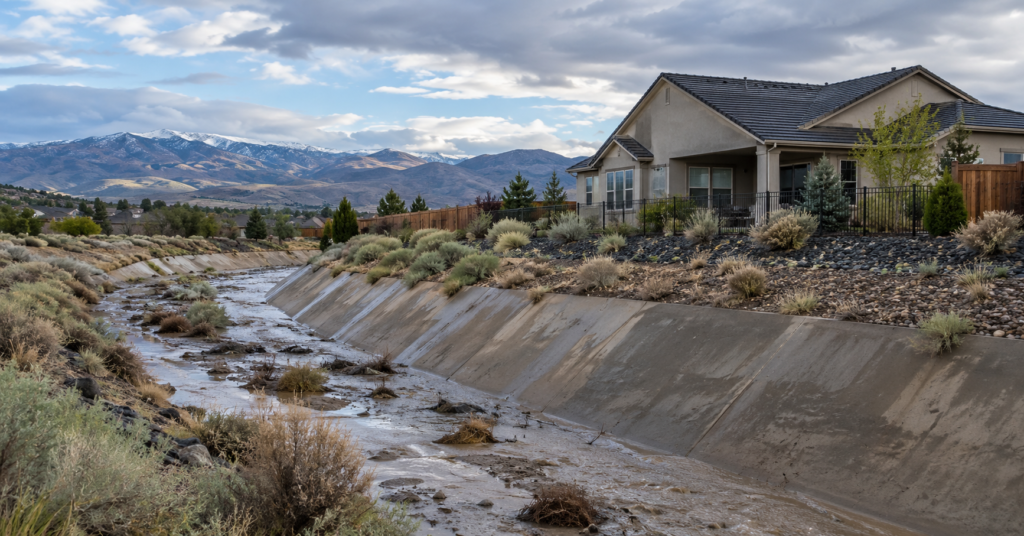
A Reno home flood risk assessment should examine more than whether the property appears inside a designated flood zone. A house located near a drainage channel, creek, wash or low-lying street may face runoff problems even when a standard listing does not identify it as a high-risk property.
Northern Nevada’s dry appearance can make flooding seem unlikely. However, rapid snowmelt, heavy rain, blocked drainage infrastructure and water moving down from higher ground can produce conditions that are not obvious during a sunny home showing.
Understand What a Flood Channel Does
A flood channel directs stormwater away from developed areas. It may look like a concrete canal, a broad dirt depression, a landscaped corridor or a mostly dry strip of land behind several houses.
The absence of water during an inspection does not mean the channel is inactive. Some channels carry water only during major storms, rapid snowmelt or unusual runoff events.
Buyers should determine:
- Where the channel begins and ends
- Whether it is natural or engineered
- Which agency or association maintains it
- How close it is to the house and accessory structures
- Whether water must cross nearby streets to reach it
- What happens if debris restricts the flow
A channel can reduce flood exposure when properly designed and maintained, but its presence also shows that water is expected to move through the surrounding area.
Start With Official Flood Mapping
Search the property address using an official flood map rather than relying on a real estate listing. The Nevada Floods website directs residents to current flood-information resources, while the FEMA Flood Map Service Center provides access to the National Flood Hazard Layer and applicable map panels.
Confirm the location of the actual structure, not merely the center of the parcel. A large lot can contain more than one flood designation, and a channel may cross one portion while the house sits elsewhere.
Important mapping details can include:
- The assigned flood zone
- The boundary of a mapped floodplain
- Whether a regulatory floodway is present
- Base flood elevation information
- Map revision dates
- Letters or amendments affecting the parcel
- Nearby drainage features
Save a copy of the map used during the purchase. Flood maps can be revised as new studies, development and drainage projects change the available information.
Why a Flood Map Is Only One Part of the Review
Flood maps are valuable, but they do not predict exactly what will happen to an individual home. Localized runoff, blocked culverts, street grading and drainage modifications may create problems that a broader map does not reveal.
A property outside a high-risk mapped zone can still experience water intrusion. Similarly, a property within a mapped area may have elevation, drainage or mitigation features that affect its specific exposure.
Treat the map as the beginning of the investigation. Combine it with an on-site inspection, insurance research, property records and questions about previous water events.
The Nevada Flood Awareness Committee notes that Nevada has a significant history of river flooding despite being the nation’s driest state.
Examine the Property’s Elevation and Grading
During the home inspection, observe how the land slopes around the building. Soil should generally direct surface water away from the foundation rather than allowing it to collect against walls.
Look for:
- A house positioned below the street
- A backyard that slopes toward the structure
- Low areas holding water or sediment
- Soil erosion around fences and walls
- Downspouts emptying beside the foundation
- Patios directing water toward exterior doors
- Retaining walls without visible drainage
- Neighboring lots located substantially uphill
- Garage floors lower than the surrounding driveway
A standard inspection may identify visible concerns, but it does not provide a full hydrological or elevation analysis. A surveyor, drainage professional, engineer or other qualified specialist may be needed when the site has complicated grading.
Study the Route Water Would Take
Imagine water approaching the property from several directions. Consider runoff from the street, adjacent lots, hillsides, roofs and paved surfaces.
A house can sit above the nearest channel yet remain vulnerable if runoff must travel past the garage or through the backyard to reach that channel. A raised curb, replacement fence, shed or landscaping wall may redirect the flow.
Walk the perimeter and identify:
- Where water would enter the lot
- Where it is expected to exit
- Whether fences interrupt the route
- Whether gates have gaps for drainage
- Whether neighboring improvements change the flow
- What lies between the home and the channel
Repeat the exterior review after rain when possible. Watermarks, deposited soil and flattened vegetation can reveal routes that are difficult to recognize in dry weather.
Check Culverts, Inlets and Channel Condition
Drainage systems depend on open pathways. Leaves, sediment, dumped materials and uncontrolled vegetation can reduce capacity or force water in an unintended direction.
A buyer should visually inspect accessible areas without entering a channel or crossing restricted property. Note blocked grates, damaged concrete, eroded banks or standing water that may indicate inadequate flow.
Do not assume the homeowner can personally clear or modify a public channel. Contact the appropriate authority when maintenance responsibilities are unclear.
Flooding on a City of Reno road or public right-of-way can be reported through the contact information provided by the City of Reno. Washoe County maintains separate reporting channels for areas under county jurisdiction.
Identify Drainage Easements Before Closing
A drainage easement can give a government agency, utility, association or another authorized party certain rights to use part of the property for water management. It may limit where the owner can construct fences, walls, sheds, pools or additions.
Review the preliminary title report, recorded subdivision map, survey and other closing documents for easements. Do not rely only on visible conditions because an easement may exist even when no obvious channel crosses the lot.
Questions to resolve include:
- Where the easement is located
- Who benefits from it
- Who is responsible for maintenance
- What improvements are prohibited
- Whether existing structures encroach upon it
- Whether authorized workers may enter the property
- Whether landscaping can be removed for maintenance
A fence or shed already standing inside an easement does not prove that it was approved. Unresolved encroachments may affect future improvements and could become the buyer’s responsibility.
Investigate Previous Water Intrusion
Ask the seller specific questions about flooding, runoff, drainage repairs and moisture inside the home. General questions about whether the house has “ever flooded” may produce an incomplete answer if previous water entered only the garage, crawl space or yard.
Request information about:
- Water entering the house, garage or crawl space
- Yard or driveway flooding
- Drainage work completed by prior owners
- Foundation repairs
- Replaced drywall, insulation or flooring
- Insurance claims involving water
- Mold treatment
- Sump pumps or temporary barriers
- Flooding on surrounding streets
- HOA drainage projects or assessments
Compare the seller’s answers with the physical evidence. Fresh paint, new baseboards or recently replaced flooring in one isolated area deserve further review, particularly when accompanied by staining or musty odors.
Look for Evidence That Water Has Reached the Property
Past water movement can leave recognizable signs even after the area has dried. An inspector may notice discoloration, efflorescence on masonry, swollen trim, rusted fasteners, deteriorated drywall or sediment inside a garage.
Exterior indicators can include:
- Erosion lines along the yard
- Debris trapped against fencing
- Soil deposited beside walls
- Uneven or repaired landscaping
- Cracks around drainage structures
- Watermarks on retaining walls
- Repeated patching near exterior doors
- Raised mechanical equipment
No single sign confirms a flooding history. Several related conditions in the same portion of the property justify a specialized evaluation.
Inspect Crawl Spaces and Lower Areas Carefully
Homes with crawl spaces or lower-level rooms require additional attention because moisture may remain hidden from the main living area.
An inspector should look for damp soil, damaged insulation, fungal growth, corroded components and attempts to conceal staining. Ventilation problems and plumbing leaks must also be considered because not every moisture condition originates from outside flooding.
If the property uses a sump pump, ask why it was installed, where it discharges and whether backup power is available. A pump is not automatically a negative feature, but the buyer should understand what water problem it is intended to manage.
Separate Flooding From Sewer Backup
Surface flooding and sewer backup can cause similar interior damage but may involve different prevention methods and insurance coverage.
Ask whether previous water entered through doors and walls, rose through floor drains or backed up through plumbing fixtures. The answer can affect the type of inspection and insurance endorsement the buyer needs.
Properties with older underground systems may warrant additional investigation. Buyers reviewing an older Nevada home can also read our guide to cast-iron sewer lines for related inspection considerations.
Request an Insurance Quote During Due Diligence
Do not wait until the final days before closing to investigate insurance. Provide the agent with the exact address, intended occupancy, lender requirements and available property information.
Ask separately about:
- Flood insurance
- Standard homeowners coverage
- Sewer or drain backup coverage
- Water damage exclusions
- Deductibles
- Coverage for detached structures
- Temporary living expenses
- Replacement-cost limitations
- Previous claims affecting eligibility
A standard homeowners policy generally should not be assumed to cover external flooding. Policy definitions and exclusions matter, so request written explanations from a licensed insurance professional.
The current owner’s premium also may not predict what a new buyer will pay. Coverage limits, rating information and policy structures can differ.
Determine Whether the Lender Will Require Flood Insurance
A lender may require flood insurance when a financed structure is located within certain mapped high-risk areas. The determination should identify the location of the building in relation to the mapped zone.
If the result appears inconsistent with the property’s elevation or an available map amendment, ask the lender what documentation would be needed for a review. Do not assume the issue can be corrected quickly after closing.
Even when a lender does not require a policy, the buyer can still request a voluntary flood-insurance quote. The absence of a lending requirement does not establish that the home has no exposure.
Review Development Above and Around the Property
New roads, houses and commercial projects can change the amount and speed of runoff reaching an area. Engineered detention basins and drainage improvements may control that water, but the buyer should understand the system rather than assuming nearby development has no effect.
Search local planning and permit records for major projects around the property. Ask whether drainage improvements are complete, still under construction or maintained by an HOA.
Pay attention to vacant land uphill. Its future development could change surrounding conditions, even when current runoff appears limited.
Consider Snowmelt and Frozen Ground
Reno’s flood exposure is not limited to summer thunderstorms. Rain falling on snow, rapid warming and frozen or saturated ground can create runoff that behaves differently from an ordinary rain event.
A home shown during a dry season may conceal seasonal conditions such as:
- Snow stored against the foundation
- Roof melt draining toward entrances
- Ice blocking a drainage inlet
- Water crossing the driveway
- Saturated soil around a crawl space
- Street runoff entering a low garage
Ask how snow is managed on the property and where plowed snow accumulates. A convenient storage location during winter should not block the lot’s intended drainage path.
Evaluate Walls, Fences and Landscaping
Homeowners sometimes install walls, decorative berms or solid fencing to keep water out. These improvements can help in one area while pushing runoff toward another part of the property—or toward a neighbor.
Check whether significant grading or retaining-wall work received required approval. A professional can determine whether the design includes appropriate drainage and whether it affects an easement.
Landscaping should not be treated as a substitute for engineered flood protection. Gravel, artificial turf and decorative rock can still allow fast-moving surface water to reach the building.
Compare the Risk With the Purchase Price
A property near a flood channel may still be a reasonable purchase when the exposure is understood, the home is properly protected and insurance is available at an acceptable cost.
Include the following expenses in the ownership calculation:
- Flood-insurance premiums
- Sewer-backup endorsements
- Drainage maintenance
- Professional inspections
- Grading corrections
- Sump-pump maintenance
- Flood-resistant improvements
- Possible HOA assessments
- Higher deductibles
A lower purchase price may not compensate for an expensive unresolved drainage problem. Conversely, the presence of a nearby channel should not automatically disqualify a well-designed property.
Use Inspection and Insurance Deadlines Wisely
Schedule the home inspection early enough to allow follow-up evaluations. If the general inspector recommends a drainage, structural, mold or sewer specialist, the buyer needs time to arrange that work and review the results.
Contract protections should be discussed with the buyer’s Nevada real estate agent or attorney. Depending on the agreement, relevant issues may include inspection, insurance, appraisal, title and document-review contingencies.
Possible responses to a discovered concern can include requesting additional records, obtaining repair estimates, renegotiating the price or deciding that the exposure exceeds the buyer’s comfort level.
Reno Home Flood Risk Questions Before Closing
Before completing the purchase, the buyer should be able to answer these questions:
- What flood designation applies to the structure?
- How close is the nearest channel, creek or wash?
- Where does runoff enter and leave the lot?
- Are any drainage easements recorded?
- Who maintains the nearby channel?
- Has water previously entered any structure?
- Are existing walls or fences affecting drainage?
- Does the lender require flood insurance?
- What coverage is available voluntarily?
- Are there unresolved drainage or moisture repairs?
- Could future development change runoff patterns?
Answers should be supported by maps, records, inspections or written explanations whenever possible.
Buyers who expect to travel on unpaved roads around northern Nevada may also find our guide to Nevada dirt roads after rain useful for understanding how quickly wet conditions can affect local access.
Keep the Records After Purchase
Retain the flood determination, survey, title documents, inspection reports, insurance records and photographs from the purchase. These materials can help with future maintenance, claims, improvements and resale.
Photograph the property’s drainage features when they are clean and functioning. If a later storm causes erosion or damage, the earlier images can show how conditions changed.
Recheck insurance and emergency preparations periodically. Maps, premiums, nearby development and physical drainage conditions can change during a long period of ownership.
Note: This article provides general information and is not engineering, surveying, insurance, legal or real estate advice. Flood conditions can vary by parcel, and maps cannot guarantee whether a particular property will flood. Buyers should verify the address with the appropriate government agencies and consult qualified Nevada professionals before purchasing.